Celebrating Independence: The Story Behind the Seeing Eye Guide Dog Anniversary
Every year on January 29, we celebrate the Seeing Eye Guide Dog Anniversary, a date that marks a pivotal moment in the history of accessibility and independence. It was on this day in 1929 that The Seeing Eye, the first guide dog school in the United States, was officially incorporated in Nashville, Tennessee.
While guide dogs are a familiar sight today, less than a century ago, the idea of a dog safely navigating a person with low vision through city traffic was considered impossible. This anniversary celebrates the courage of a young man, a visionary dog trainer, and a German Shepherd named Buddy who proved the world wrong.
The Spark: A Magazine Article
The movement began not with a business plan, but with a letter. In 1927, The Saturday Evening Post published an article titled “The Seeing Eye” by Dorothy Harrison Eustis, an American dog breeder living in Switzerland. Eustis wrote about schools in Germany that were training dogs to assist soldiers blinded in World War I, describing the dogs as “eyes, sword, and shield” for their handlers.
Back in Nashville, a 20-year-old man with blindness named Morris Frank heard the article and saw a path to freedom. He wrote to Eustis, promising that if she would train him, he would return to America and help other people with low vision find the same independence.
Morris and Buddy: The First Team
Eustis agreed, and Frank traveled to Switzerland to train at her kennel, Fortunate Fields. He was paired with a female German Shepherd named Kiss, whom he promptly renamed Buddy.
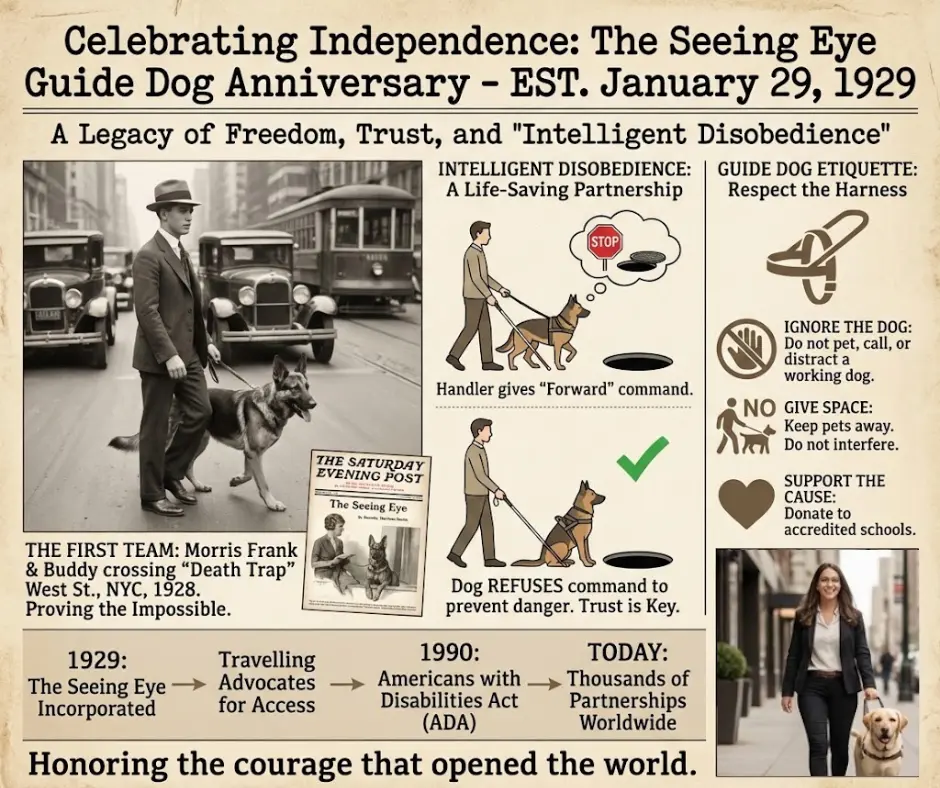
The training was rigorous. Frank had to learn to trust Buddy with his life, and Buddy had to learn “intelligent disobedience”—the ability to refuse a command if it would put her handler in danger.
The Test That Changed History
When Frank and Buddy returned to the United States in 1928, they faced skepticism from the press. To prove Buddy’s ability, Frank performed a terrifying demonstration for reporters: he had Buddy guide him across West Street in New York City, a chaotic, dangerous waterfront street known as a “death trap” for pedestrians.
Buddy navigated the traffic flawlessly. This success paved the way for the founding of The Seeing Eye on January 29, 1929.
Beyond Companionship: A Civil Rights Legacy
The anniversary we celebrate today is about more than just the bond between human and dog; it is about civil rights. When Morris Frank first began traveling with Buddy, they were frequently denied entry to restaurants, hotels, and public transport.
Frank and Buddy became traveling advocates, lobbying for the right of guide dog users to access public spaces. Their work laid the foundation for the access laws we have today, including the Americans with Disabilities Act (ADA).
How to Observe the Day
While “Seeing Eye dog” is often used as a generic term, it technically refers only to dogs trained by The Seeing Eye school in Morristown, New Jersey (where the school moved in 1931). However, you can use this day to honor all legitimate guide dog teams:
Learn the Etiquette: The most important rule is to ignore the dog. If a dog is in a harness, it is working. Do not pet, call out to, or distract the dog, as this puts the handler’s safety at risk.
Support the Cause: Consider donating to accredited guide dog schools. These organizations are often non-profits that provide dogs to handlers at little to no cost.
Spread Awareness: Share the story of Morris and Buddy. Remind people that the independence many people with low vision enjoy today started with one person refusing to accept limitations.
On January 29, we honor the legacy of Buddy and Morris Frank—a partnership that opened the world for thousands of people, one step at a time.